Date: 1/10
Time: 7:15-9:00
Location: Field off of Hawkins Road
Clouds: 5% until 8:45 when the clouds started rolling in.
Temperature: 68 degrees
Moon: The moon was not visible from our location.
Light Pollution: At a minimal, could see the pollution from Venice reflecting from the clouds.
Tools: Green laser, binoculars, telescope, and eyes.
Constellations: Cygnus, Eridanus, Monoceros, Gemini, Orion, Perseus, Cepheus, Draco, Ursa Minor, Cassiopeia, Pegasus, Andromeda, Pisces, Aries, Cetus, and Taurus.
Planets/Stars: Mars, Deneb, Polaris, Castor, Pollux, Capella, Pleiades, Algol, and Mira.
M Objects:M1 (Crab Nebula), M42, M35, M31, M36, and M37.
Misc: Great Square, andcirclet.
Sunday, January 13, 2008

Friday, January 11, 2008
2nd Quarter Bibliography
Cameron Johnson
Mr. Percival
1/11/08
Period 0
Charles Messier
Born in the quaint town of Badonvillier Lorraine, France, Charles Messier has just one out of the twelve sons and daughters of his parents in June 26, 1730. He was enrolled in school at an early age and by the age of fourteen; his interest in astronomy took off. One night he saw a six-tailed comet which spiked his interest and would be the beginning of his career in astronomy. A solar eclipse not long after only fueled his interest and would help him determine that his passion would be astronomy. Messier decided to travel to Paris in October of 1751 where he found employment with the navy mainly because of his penmanship. While at sea, he kept detailed drawings of the nighttime sky as well as mapped the coast line of China. Messier later found habitual employment in the navy as a Depot Clerk in 1754.
In 1758, Messier spotted Halley’s Comet that was expected to appear again during sometime that year. However, a couple months previous to this spotting, a German farmer discovered that comet which only fueled Messier to discover additional comets. In 1764, he discovered the comet again and for fifteen years, he would be credited with the most comet discoveries during that time period. His observations did not solely focus on comets during this time as eclipses, sun spots on the Sun, and nebulae greatly interested him. One of his most important discoveries came in 1758 where he discovered M1, the Crab nebula. This would be the first in hundreds of nebulae that would be discovered and observed by him throughout his lifetime. Four years later, he discovered the globular cluster located in the constellation of Aquarius. Messier was determined to catalog as many M objects as possible in his lifetime. As 1764 approached its final few months, Messier discovered the Dumbbell, Hercules, Andromeda, Omega, and Trifid nebula's and galaxies. This was quite an accomplishment and allowed him the recognition he wanted while in France’s Navy. His goal was to make his catalog as complete and well detailed as possible so he would be known for his crucial contributions in astronomy.
By 1769, Messier’s astronomical list reached an impressive forty-five objects some of them including the Pleiades, Praesepe, Sirius, and the position of the previously discovered Orion nebula. During the next year, Messier was accepted to the Royal Academy of Sciences. Most of these object’s discovery was the result of following and observing the paths of comets that intrigued Messier. As these comets passed across the sky, it would give him the ability to spot galaxies and nebulae that could not have been previously observed which is why cataloging the comets during the year was so crucial to his work. The year 1880 brought the list to sixty-eight objects which were published in the French almanac. His work quickly spread and he finally got him recognized as a top researcher in his field. The telescope of his choice was the Gregorian reflector which was one of the most accurate telescopes of his time. In 1781, Messier’s rival, Pierre Mechain, observed thirty-two objects that have never been recorded so Messier pinpointed their location and added them to his list. Charles Messier’s list reached an amazing one hundred with detailed descriptions and locations by 1790. During that same year, Messier took a nasty fall, leaving him with several broken bones and the inability to do anymore observations until a year had passed. Two years after he resumed observations, his complete list was published and was the reference book to many future astronomers who had the same passion he had. However, the early 1790s brought about rough times for Messier with the economy in shambles as well as a revolution underway. Messier found himself unemployed and struggling to make ends meet. In 1793, he made his last discovery of a comet and was finally nominated into the Academy of Sciences and then received a very prestigious award from Napoleon Bonaparte named the Legion of Honor. On April 12, 1817, Charles Messier passed away at the age of 86 leaving amazing accomplishments in the field of astronomy that would helped the world understand space and the objects that occupy it.
http://seds.lpl.arizona.edu/messier/xtra/history/CMessier.html
http://adsabs.harvard.edu/full/1902AnHar..38....1B
http://seds.org/~spider/
http://www.hawastsoc.org/messier/index.html
Thursday, January 10, 2008
2.9 Apod Entry
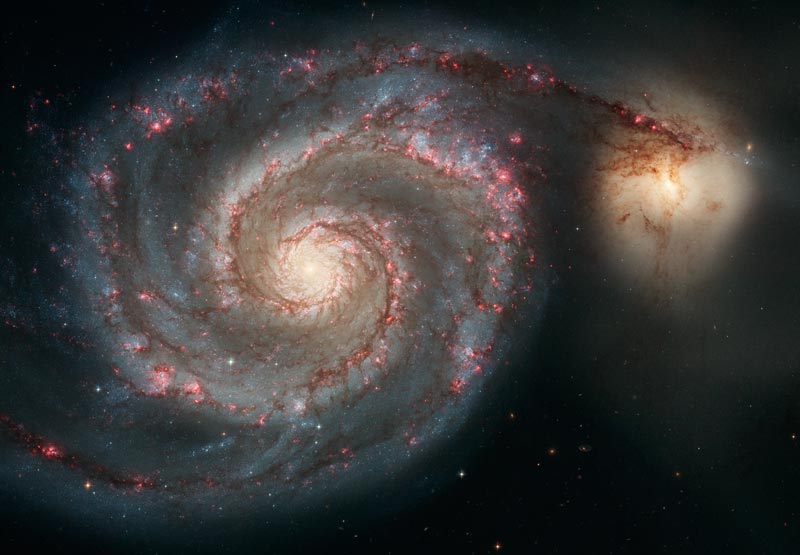
The photo for the week of January 5 is of M51: Cosmic Whirlpool. This stunning photo is of the M51 which Charles Messier cataloged. It is believed that is the the oldest spiral nebula which is quite apparent when you look at the shape and figure. Off in the top right of this photo is the neighboring galaxy NGC 5195. The distance between the two is a calculated 31 million light-years and are situated in the constellation Canes Venatici. The photo was taken from the Hubble Space Telescope.
2.8 Apod Entry

The photo for the week of December 15 is the Mountain of Creation. The Spitzer Space Telescope took this infrared photo of this sky scape located in the constellation of Cassiopeia. This about about 7,000 light-years from Earth. Distant stars have been emitted radiation and winds that have shaped these clouds into what they currently look like. The telescope also captured newly formed stars which result from nearby gigantic stars. This region is also classified as part of the Heart and Soul Nebulae.
Friday, December 14, 2007
2.7 Apod Entry

The photo for this week is of the Eagle Nebula taken on December 9, 2007. The dark cloud-like figures are apparently evaporating. The light emitted by close and distant stars are eating away at these cosmic clouds. This particular cloud is known as the the gigantic alien fairy. The fairy is just one of many dust pillars that are in the Eagle Nebula or M16. The height is a staggering 10 light years and the radiation emitted by the Fairy is more hotter than radiation emitted by a fire. An open cluster is currently forming inside the cavity of this nebula.
Friday, December 7, 2007
Observation 12/6
Date: 12/6/07
Time:8:15-9:00pm
Location: Church off of Hawkins Road
Tools Used: Naked eye, laser pointer, binoculars, and two telescopes.
Light Pollution: Minimal, only a few lights visible in the northern direction.
Cloud Coverage: 5%-8%
Temperature: 58-65 degrees
Moon: The moon was not visible and it was at apogee, so it was the farthest from Earth in its orbit-406,235km
Constellations: Andromeda, Ursa Minor (Little Dipper), Lyra, Delphinus, Cassiopeia, Cepheus, Pegasus (Great Square), Persus, Pisces, Cetus, Cygnus (Northern Cross), and Aquarius.
Planets: Mars and Uranus
Stars: Polaris (and faint star at 1 o'clock), Vega, Gemini Twins, Deneb.
Miscellaneous: Gamma, Andromeda, M42 (Orion Nebula), and a shooting star in the northwest direction.
2.6 Apod Entry
The entry for this week is of the Double Cluster in the constellation of Persus or the Hero. This star field is not too far from the Comet Holmes which astronomers have been following closely.The Double Cluster is 7,000 light years and is visible with the naked eye on dark nights.Hipparchus was the first astronomer to identified this cluster in 130 BC.The cluster on the left is cataloged in as NGC 869 and the cluster on the right is NGC884.Inside the cluster are stars that are estimated to have temperatures that far exceed that of the Sun. These two clusters have a distance between them of about acouple hundred light years.
Subscribe to:
Posts (Atom)